New Discoveries in Yellowstone

Its easy to think of Yellowstone as a constantly changing place. Wildfires, erosion, weather, etc. all play a role in noticeable changes to the landscape. Smaller changes are happening in the thermal areas as well. Channels of water change course creating new pools and enabling new microscopic life to thrive. Old springs dry up and new ones form. Even seasonal temperature fluctuations can affect the thermal areas. If you're not a frequent visitor to the park you may not notice most of these changes as they can be very subtle. Occasionally the changes can be quite dramatic.
For years the boardwalk around the upper terraces at Mammoth Hot Springs has been coming closer and closer to being consumed by the natural build up of the terraces. While the boardwalks offer us a safe viewing platform to many of Yellowstone's thermal areas the boardwalks themselves can be a nuisance to the untamed landscape. In Mammoth the boardwalks are often removed or rerouted as the terraces grow. The super heated water underground carries with it the minerals needed to create new terraces. Once reaching the surface, the water cools and slows and it can no longer carry the minerals and they are deposited, creating new terraces. This cooling and slowing of the water often takes place adjacent to the boardwalks making them easily consumed. This past spring a section of the boardwalk was highly unstable and had to be rerouted to higher ground. Shortly before the boardwalk was removed a section of the ground near the boardwalk caved in making the need for a new path even more urgent.
At first I was disappointed to see that the route had been changed and the boardwalk moved away from the thermophile-filled pools that had fascinated me for years and provided many interesting photo ops. That disappointment
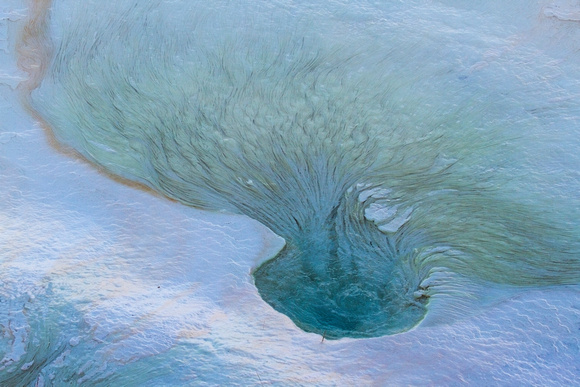 Upper Terrace Spring - Mammoth Hot Springs
 turned out to be short lived. During one of my visits this fall I was excited to see that the area that had collapsed earlier in the year had turned into a bubbling new spring and was breathing new life into the area. The spring itself appears rather small but there seems to be a great volume of water pouring out of it - enough to rejuvenate a large area of the terraces. An area that was once covered in orange colored bacteria (more common in cooler waters) is now a large expanse of white and lime green filamentous algae (more common in scalding hot waters). And further away the water flows into an area that has been dried up for many years. That area was a dead, chalky white and is now thriving with a variety of organisms making the terraces a mix of golden hues.
Comments
|
January
(1)
February (1)
(1)
March (1)
April
(2)
May (2)
(2)
June (2)
July
August
September
October
(1)
November (1)
(1)
December (1)
|
January
February
March
April
May
June
(2)
July (2)
(1)
August (1)
September
October
(1)
November (1)
December
|
January
February
March
April
May
June
July
August
September
October
November
December
|
(1)
January (1)
(1)
February (1)
March
April
May
June
July
August
September
October
November
December
|
January
February
March
April
May
June
July
August
September
October
November
December
|
January
February
March
April
May
June
July
August
September
October
November
December
|
January
February
March
April
May
June
July
August
September
October
November
December
|
January
February
March
April
May
June
July
August
September
October
November
December
|
January
February
March
April
May
June
July
August
September
October
November
December
|
January
February
March
April
May
June
July
August
September
October
November
December
|
January
February
March
April
May
June
July
August
September
October
November
December
|